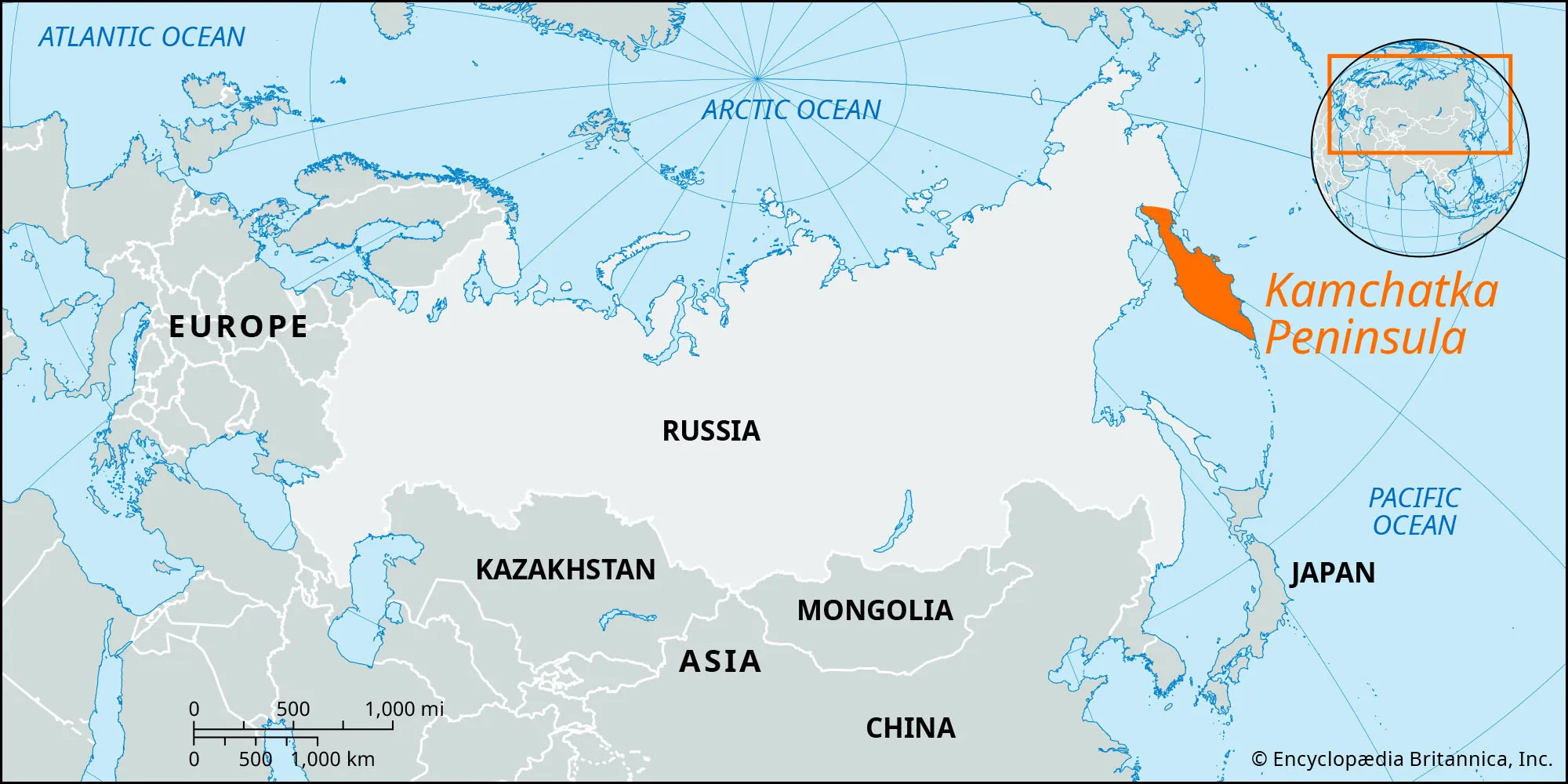
Location: Kamchatka Peninsula, Russia Status: State of Emergency
In the second week of January 2026, the Russian Far East was struck by a meteorological event of historic proportions. The Kamchatka Peninsula, a rugged land known for its volcanoes and geysers, became the epicenter of a “snow apocalypse” that shattered records standing for over a century.
Table of Contents
What Happened: A Paralyzing Deluge
Starting roughly around January 12, 2026, a relentless series of cyclones barreled into the peninsula from the Sea of Okhotsk. While Kamchatka is accustomed to harsh winters, this storm was different in its intensity and volume.
- The “Snow Apocalypse”: Over the course of just a few days, the region received more than three months’ worth of precipitation. By January 16, snow depths in some areas were reported to reach nearly 500 cm (approx. 16 feet).
- Infrastructure Collapse: The sheer weight and volume of the snow paralyzed the region.
- Buried Alive: Residents in single-story homes found themselves completely submerged. In multi-story apartment blocks, snow drifts piled as high as the second and third-floor windows.
- Tunnels for Streets: Footage from the capital, Petropavlovsk-Kamchatsky, showed residents digging elaborate tunnel networks just to exit their front doors or reach local grocery stores.
- Transport & Power: Public transport was suspended indefinitely. Cars were buried so deep they looked like mere bumps in the white landscape. Power lines snapped under the weight of ice and snow, leaving thousands without heat in sub-zero temperatures.
- Casualties: The event turned deadly when the accumulated snow became unstable. A state of emergency was declared after two people were killed in separate incidents where massive slabs of compacted snow slid off rooftops, burying them instantly.
Where: The Eye of the Storm
The crisis is centered in Petropavlovsk-Kamchatsky, the regional capital and home to roughly 180,000 people.
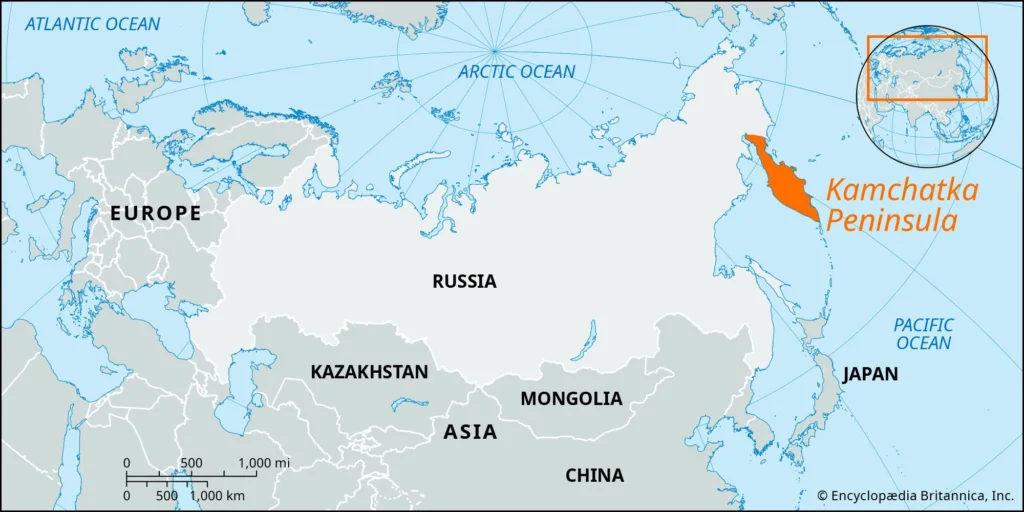
- Geography: Located on the southeastern coast of the Kamchatka Peninsula, the city sits in a natural amphitheater of hills and volcanoes. This topography trapped the cyclonic moisture, forcing it to dump its load directly over the city.
- Isolation: Kamchatka is connected to the rest of Russia only by air and sea; there are no roads linking it to the mainland. This isolation has made emergency relief efforts significantly more difficult.
The Science: Why Did This Happen?
Meteorologists attribute this extreme event to a collision of atmospheric anomalies, exacerbated by the changing global climate.
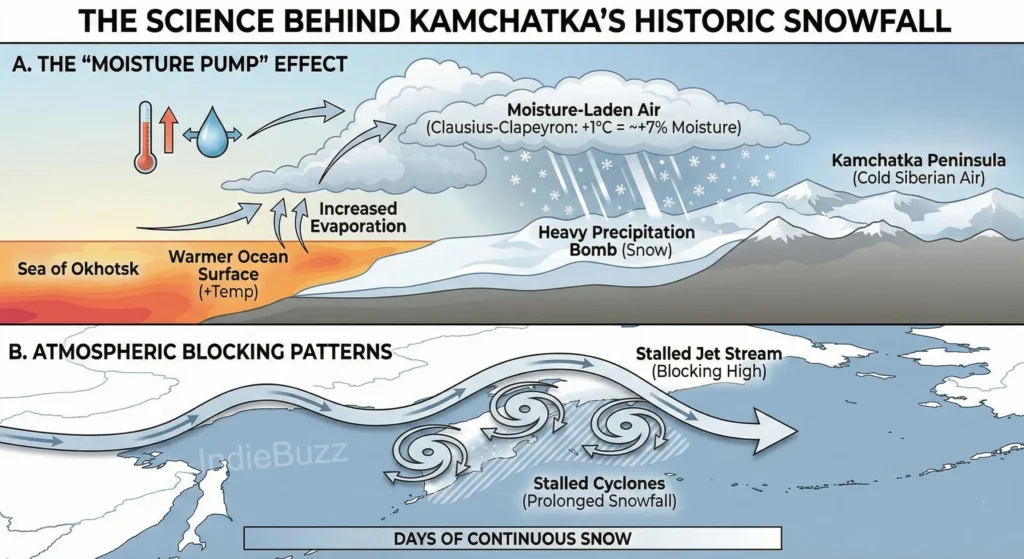
1 . The “Moisture Pump” Effect The primary driver was a sequence of deep cyclones originating in the Sea of Okhotsk. However, the volume of snow is directly linked to ocean temperatures.
- Warmer Oceans: The Pacific Ocean and Sea of Okhotsk have been recording higher-than-average surface temperatures.
- Atmospheric Physics: Basic thermodynamics (specifically the Clausius-Clapeyron relation) dictates that for every 1°C of warming, the atmosphere can hold approximately 7% more moisture.
- The Result: When these moisture-laden systems encounter the cold Siberian air over Kamchatka, the excess moisture is wrung out violently as snow. Essentially, a warmer planet does not always mean less snow; in high latitudes, it often means heavier snow.
2. Blocking Patterns Atmospheric blocking patterns stalled the cyclones over the peninsula. Instead of moving on, the storms sat over the region, dumping snow continuously for days.
Global Context: A World in Flux
The events in Kamchatka are not isolated. They are part of a disturbing pattern of “weather whiplash” observed globally throughout late 2025 and early 2026. As the jet stream weakens and wobbles due to Arctic warming, weather systems are becoming “stuck” in place, leading to prolonged and extreme conditions.
Recent Anomalies (2025-2026):
- Southern Africa (Late 2025): While Russia froze, parts of Mozambique and Zimbabwe faced devastating floods driven by stalled tropical storms, displacing thousands.
- Western Europe (Jan 2026): Simultaneous with the Kamchatka snow, sudden stratospheric warming events triggered severe cold snaps in parts of Europe, straining energy grids.
- South America: Conversely, regions in Chile and Argentina have faced unprecedented heatwaves and wildfires during their summer season, further destabilizing the cryosphere (glacial ice) in the Andes.
What to Expect and The Way Forward
We are entering an era of non-stationary climate, where historical weather records are no longer reliable predictors of future weather patterns.
What We Can Expect:
- Heavier Precipitation Events: As global temperatures rise, we will see more “precipitation bombs”—whether rain or snow.
- Infrastructure Stress: Buildings, drainage systems, and power grids designed for the 20th-century climate will increasingly fail under 21st-century extremes.
The Way Forward:
- Hard Adaptation: Cities in high-latitude regions must revise building codes to withstand heavier snow loads. “Snow management” will become as critical as “flood management” is for coastal cities.
- Improved Forecasting: We need better predictive models for “stalled” weather systems to give residents days, rather than hours, to prepare.
- Global Mitigation: Ultimately, these events are symptoms of a planetary energy imbalance. Reducing carbon emissions is the only way to stabilize the atmospheric thermostat and prevent these “100-year events” from becoming annual occurrences.