✒️ From Editor’s Pen
From the Taj Mahal to the Delhi Metro, why do we treat our motherland like a giant dustbin? It’s time for a national reality check (and maybe a bit of roasting).
Let’s be real for a second, friends. We Indians are a passionate bunch. We tear up when the national anthem plays, we turn into keyboard warriors defending our culture online, and we proudly sport “I Love My India” stickers on our cars.
But there’s a massive, smelly elephant in the room that we’re all stepping over, literally.
Despite our ancient wisdom and soaring ambitions, our collective “civic sense” seems to be stuck in a perpetual buffering mode. We have impeccable personal hygiene—we bathe daily, our homes are spotless—but the moment we step past our front door, the world becomes our personal spittoon and garbage dump.
Let’s dive into this messy affair, ask some tough questions, and figure out how we can stop being part of the problem.
Table of Contents
The “Highlights” Reel of Shame
If you think I’m exaggerating, let’s look at a couple of recent incidents that made us all collectively face-palm.
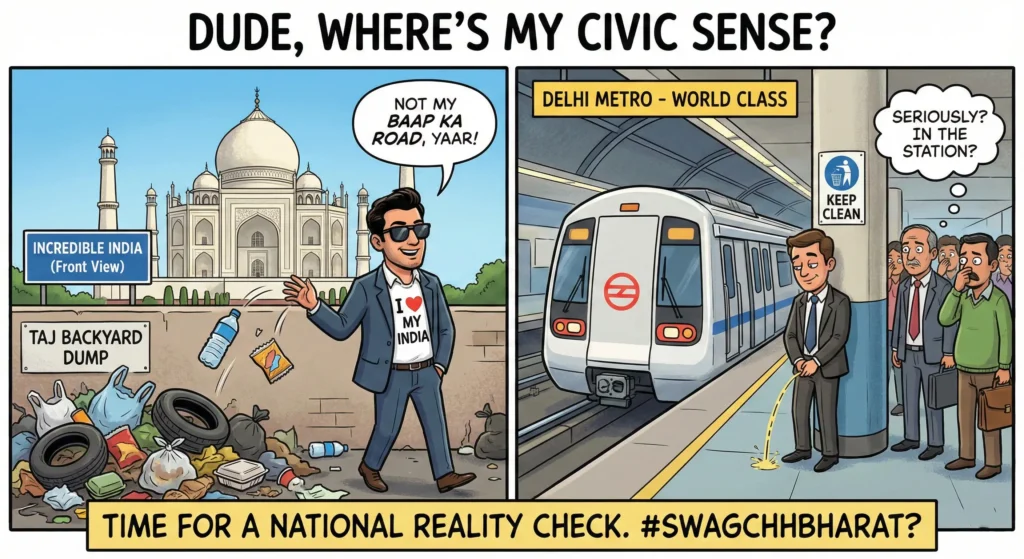
1. The Taj Mahal’s Backyard: The Taj Mahal is the jewel in India’s crown, a UNESCO World Heritage site, an ode to eternal love. Recently, images went viral showing the area immediately behind the Taj, on the banks of the Yamuna, looking like a dystopian landfill. Plastic bags, bottles, and filth piled high, just meters away from the pristine marble. It’s like wearing an Armani suit but forgetting to wear pants. What are we telling the world? That we love history, but only the front view?
2. The Delhi Metro Streamer: The Delhi Metro is world-class. It’s efficient, clean, and a marvel of modern infrastructure. Yet, we had a viral video of a man casually urinating inside the metro station. Inside. Why? Was the bathroom too far? Was it a bizarre territorial marking ritual? It highlights a shocking lack of respect for shared public resources.
And let’s not forget the everyday classics: rolling down the car window to throw a wafer packet onto the highway, or spitting paan stains on freshly painted walls as if it’s modern art.
The “Not My Baap Ka Road” Syndrome
Why do we do this?
The core issue isn’t a lack of dustbins; it’s a lack of ownership. We suffer from an acute case of “It’s not my job.”
We view public spaces—roads, parks, monuments, trains—as “government property,” not our property. We assume that because we pay taxes (grudgingly), there’s an invisible army of sweepers waiting to catch our dropping litter before it hits the ground.
This apathy, combined with a “Chalta Hai” (it’s okay) attitude, is a lethal combination for cleanliness. We see a pile of garbage and think, “Well, one more wrapper won’t make a difference.” Spoiler alert: It does.
The Government: Trying, But…
To be fair, the government has woken up.
The Swachh Bharat Abhiyan (Clean India Mission), launched in 2014, was a massive jolt to the system.
- Fact Check: It successfully built millions of toilets, drastically reducing open defecation in rural areas. It brought the conversation of sanitation to the dinner table.
But here’s the catch: The government can build infrastructure, but it cannot build character. They can install a dustbin every ten feet, but they can’t force your hand to drop the wrapper inside it. Swachh Bharat isn’t just about brooms; it’s about brains.
The Moral Duty: Why Cleanliness Actually Matters
Forget the government for a minute. Let’s talk about Karma and basic decency. Why should we keep our surroundings clean?
- Health is Wealth (Literally): Those garbage dumps are five-star hotels for mosquitoes, rats, and stray animals. Dengue, malaria, and typhoid don’t care if you are rich or poor; they thrive on our filth.
- The “Atithi Devo Bhava” Fail: We want tourism dollars. We want the world to respect us as a superpower. But nobody wants to vacation in a garbage dump. A dirty country loses money and prestige.
- A Reflection of Self-Respect: How we treat our shared spaces is a reflection of how we view ourselves as a society. A clean environment lifts morale; a dirty one breeds cynicism.
Your moral duty is simple: Leave a place better (or at least the same) than you found it.
Beacons of Hope: The Guys Getting it Right
It’s not all doom and gloom. There are shining examples that prove we can change.
- Indore, The Undefeated Champ: For several years running, Indore has been voted India’s cleanest city. How? It wasn’t magic. It was a strict administration combined with massive public participation. The citizens of Indore now take pride in policing their own city. They stopped accepting litter as “normal.”
- Citizen Movements: Across the country, there are “spot-fixer” groups—citizens who gather on weekends to clean up, paint walls, and reclaim ugly spots in their cities, without waiting for the municipality.
The Call to Action: Don’t Be That Guy
Changing India doesn’t require you to quit your job and become a full-time social worker. It just requires tiny adjustments in daily behavior.
Here is your Civic Sense Starter Pack:
- The Pocket Rule: If you hold a wrapper, ticket, or tissue, put it in your pocket or bag until you find a dustbin. Your pocket won’t die of toxic shock syndrome.
- Call It Out (Politely): If you see someone littering, a gentle “Excuse me, uncle/aunty, you dropped something” can sometimes shame them into picking it up. (Use your judgment on safety here!).
- Stop the “Flying Spit”: Just don’t do it. It’s gross, it spreads disease, and it ruins public property.
- Segregate at Home: The battle begins in your kitchen. Separate wet and dry waste. It makes the life of sanitation workers infinitely easier.
India is incredible. Let’s stop treating it like it’s disposable. The next time you’re about to toss something on the ground, remember: you aren’t just littering a street; you’re trashing your own home.
Let’s clean up our act, India. One wrapper at a time.