✒️ From Editor’s Pen
In the collective conscience of our society, the word “victim” in a marriage almost instinctively conjures the image of a woman. This is for good reason—centuries of systemic oppression have necessitated strong laws to protect women. But in our quest for justice, have we developed a blind spot?
Recent trends and statistics from the National Crime Records Bureau (NCRB) reveal a chilling reality: thousands of Indian men end their lives every year due to “family problems” and “marriage-related issues.” Among these are heartbreaking stories of men driven to despair by extra-marital affairs, emotional abuse, and the weaponization of the very laws designed to protect the sanctity of marriage.
This article aims to shed light on this uncomfortable truth, not to diminish the struggles of women, but to expand our circle of empathy to include men, advocating for a truly egalitarian society where no gender suffers in silence.
Table of Contents
The Reality Check: What the Data Says
While media narratives often focus on dowry deaths and female harassment (which remain critical issues), the other side of the coin is rarely flipped.
- The Suicide Gap: According to recent NCRB data, married men are significantly more likely to commit suicide than married women. In 2021 alone, approximately 81,000 married men took their own lives compared to 28,000 married women.
- The Trigger: “Family Problems” is consistently cited as the leading cause of suicide for men in India, accounting for nearly 33% of all male suicides.
- The Specific Trauma: There is a rising pattern of men discovering a partner’s extra-marital affair, only to be met not with apology, but with threats of false legal cases if they speak up. This entrapment—emotional betrayal coupled with legal fear—is a lethal cocktail.
The Legal Landscape: A skewed Battleground?
One of the biggest contributors to this sense of helplessness is the Indian legal framework. While designed to correct historical wrongs, many laws are not gender-neutral, leaving men with few safeguards.
1. The “Shield” that Became a “Sword” (Section 498A)
- What it is: Section 498A of the IPC is designed to protect women from cruelty and dowry harassment.
- The Issue: It is non-bailable and cognizable, meaning police can arrest the husband and his family solely on a complaint. The Supreme Court of India itself has termed the misuse of this law as “Legal Terrorism,” acknowledging that it is frequently used as a weapon by disgruntled wives to blackmail husbands during matrimonial disputes.
2. Domestic Violence is “Gendered”
In India, the Protection of Women from Domestic Violence Act, 2005 recognizes only women as victims.
- Global Context: In countries like the UK, USA, and Canada, domestic violence laws are gender-neutral. A man can file for a restraining order against an abusive wife just as easily as she can against him.
- Indian Context: If a man is beaten, spat on, or emotionally abused by his wife, there is no specific “Domestic Violence Act” for him to invoke. He has to rely on general penal codes (like simple hurt), which are far less effective in a domestic setting.
3. Adultery and Alimony
- While adultery is no longer a crime, it is a ground for divorce. However, societal bias often leads courts to view the mother as the primary caregiver, regardless of her conduct. Men frequently lose custody battles even when they can prove the wife was abusive or adulterous, leading to severe depression.
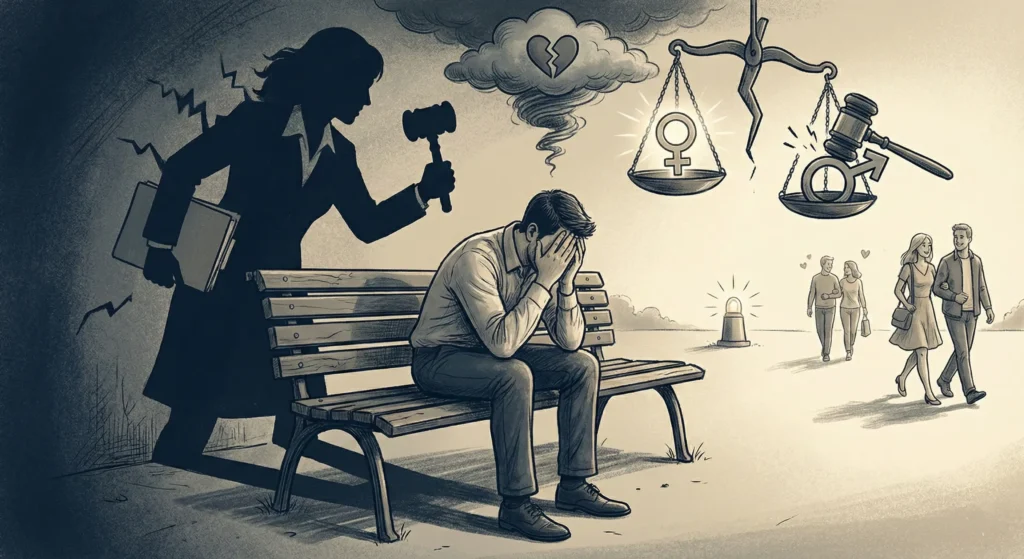
The Societal View: “Boys Don’t Cry”
Why do men choose suicide over speaking out? The answer lies in our culture.
- The Stoicism Trap: Society expects men to be “providers” and “protectors.” A man claiming to be a victim of his wife is often ridiculed or told to “man up.”
- The “Believe All Women” Paradox: While “Believe Women” is crucial for reporting sexual assault, blind belief in matrimonial disputes often presumes the man is guilty until proven innocent.
- Isolation: When a woman faces trouble, support groups, NGOs, and helplines rally around her. When a man faces marital abuse, he often finds himself isolated, fearing that if he speaks up, he will be laughed at or, worse, hit with a counter-allegation of dowry harassment.
Recent Incidents & The Need for Change
A 34-year-old engineer from Jaunpur, Uttar Pradesh, working in Bengaluru, has tragically ended his life. Atul Subhash, who worked at a private company in the city, was found dead in Marathahalli after reportedly hanging himself. His death has raised serious questions, particularly as he left behind a detailed 24-page suicide note and more than an hour-long video accusing his wife and her family of harassment. The police have initiated an extensive investigation into the case to uncover the full circumstances surrounding his death. Read the full article here.
This is not about Men vs. Women. It is about Human vs. Injustice.
A truly egalitarian society is one where:
- Laws are Gender-Neutral: Abuse has no gender. Protection from domestic violence should be a fundamental right for every citizen, male or female.
- Shared Custody is the Norm: Fatherhood should be valued as highly as motherhood.
- Perjury is Punished: Those who file false cases (false rape or dowry accusations) to settle scores must face strict legal consequences to deter the abuse of the legal system.
The Way Forward: Actionable Steps
If you are a man facing this:
- Document Everything: In the eyes of the law, evidence is God. Save chats, recordings, and emails.
- Seek Mental Health Support: Depression lies to you. It tells you there is no way out. There is always a way out.
- Legal Counsel: Consult a lawyer who specializes in men’s rights or family law. You can file for divorce on grounds of “Mental Cruelty.”
If you are a member of society:
- Listen without Judgment: If a male friend opens up about marital trouble, don’t mock him. Listen.
- Raise Sons to be Human, not just “Men”: Teach them that it is okay to be vulnerable and that their worth is not tied to their ability to endure abuse silently.
- Advocate for Neutrality: Support petitions and conversations that demand gender-neutral family laws.
Conclusion
The loss of life due to marital discord is a tragedy that transcends gender. By acknowledging the pain of male victims, we do not take away from the rights of women; we simply affirm the value of every human life. It is time to clean our societal surroundings of the toxic biases that force men into silence. Justice should not have a gender.
Helplines (India):
- Kiran (Mental Health Rehabilitation): 1800-599-0019
- Aasra (Suicide Prevention): 9820466726
- Save Indian Family Foundation (Men’s Rights NGO): +91-8882-498-498