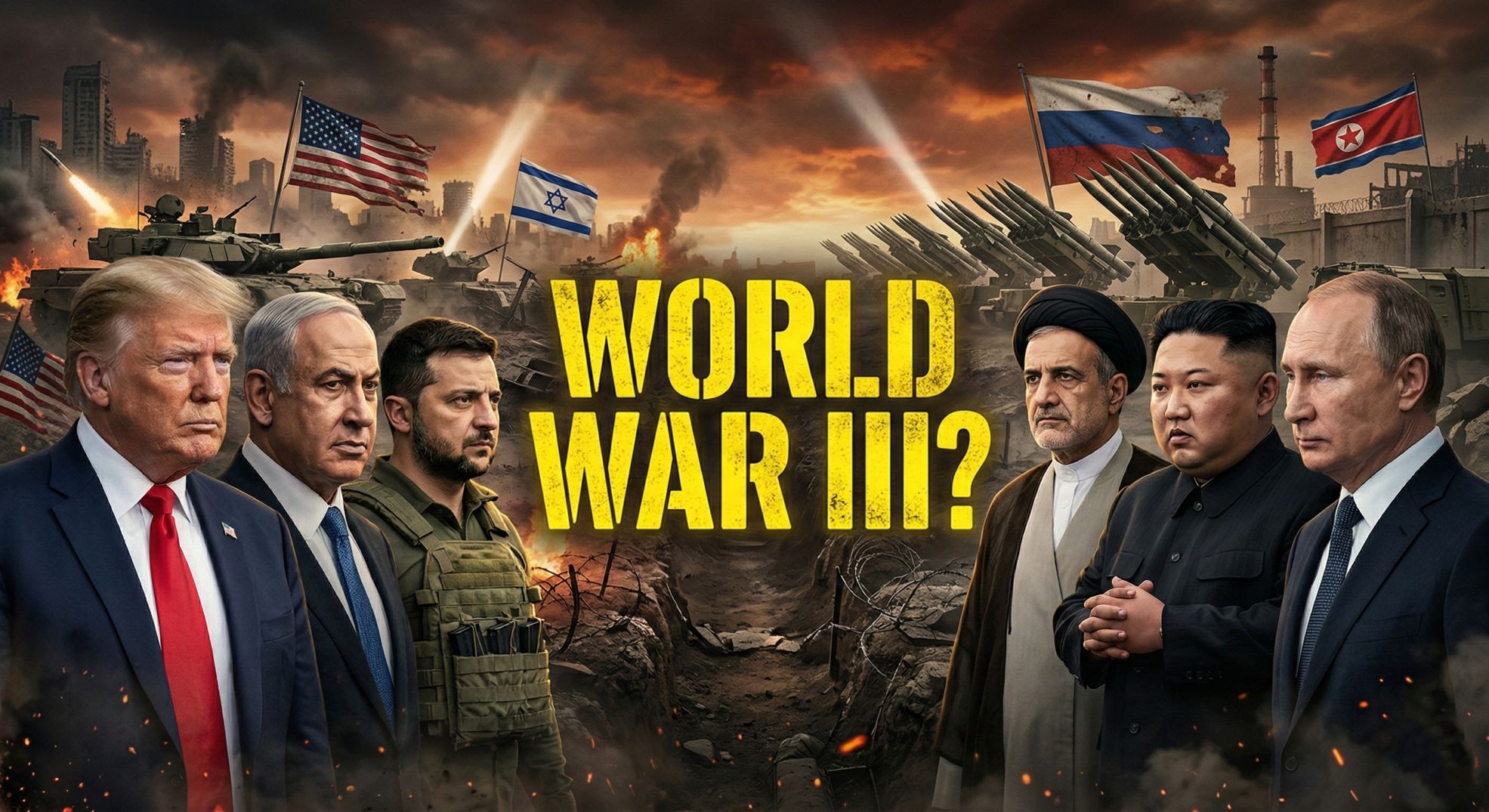
The world in March 2026 feels closer to the edge than it has in decades. With a direct, unprecedented war erupting between the U.S., Israel, and Iran, and the grueling conflict in Ukraine entering its fifth year, a terrifying question is dominating headlines and dinner table conversations alike: Are we on the brink of World War III? To understand where we are going, we have to look at the facts on the ground right now. Here is a clear, detailed breakdown of the current global conflicts, how they are surprisingly connected, and what the future might actually hold.
Table of Contents
The Epicenter: The U.S.-Israel-Iran War
For decades, Israel and Iran fought a “shadow war” through proxies and cyberattacks. In March 2026, that shadow war exploded into direct, open conflict.
What is happening now:
- Direct Strikes: The U.S. and Israel are conducting heavy, direct military strikes on Iranian government, military, and nuclear-related facilities.
- Major Casualties: The strikes have fundamentally shaken Iran’s leadership, notably resulting in the death of Supreme Leader Ayatollah Ali Khamenei.
- Iran’s Retaliation: Iran has fired back with hundreds of ballistic missiles and drones, targeting Israeli territory, U.S. military bases in the Gulf (such as the Al-Udeid base in Qatar), and commercial shipping.
- Naval Warfare: The conflict has spilled into the oceans. A U.S. submarine recently sank an Iranian warship, and commercial tankers are being struck by drones near the critical Strait of Hormuz.
Why it matters to you: The Strait of Hormuz is one of the world’s most important oil chokepoints. This conflict has already sent global oil and gas prices spiking, which will eventually impact everything from the cost of gasoline to the price of groceries worldwide.
Gaza: A Fragile Peace Threatened by New Wars
Just as the world was cautiously optimistic about a U.S.-brokered ceasefire in Gaza—backed by billions in pledged reconstruction funds—the war in Iran has thrown the region back into crisis.
The Current Status: In response to the missile exchanges with Iran, Israel indefinitely closed all border crossings into the Gaza Strip, citing severe security risks.
The Humanitarian Impact: Because Gaza relies almost entirely on outside aid after two years of devastating warfare, these closures are catastrophic. Prices for basic goods like flour have tripled overnight as panicked residents hoard supplies. Humanitarian organizations are warning that if the borders remain closed, the 2 million people in Gaza could face a severe, immediate famine.
Ukraine: The Grinding Stalemate
While the Middle East dominates the news, the largest land war in Europe since 1945 continues to grind on. Four years after Russia’s full-scale invasion, the narrative has shifted drastically.
What is happening now:
- Russia’s Crawl: Despite claims of inevitable victory, Russian forces are advancing at their slowest pace since 2024. Capturing small strips of land has come at a massive cost; military analysts estimate Russia has suffered over 1.2 million casualties since 2022.
- Ukraine’s “Wall of Drones”: The front lines remain largely stable because Ukraine has adapted. They are using a sophisticated “wall of drones” and domestically produced long-range missiles to hold off Russian advances and strike back at Russian oil terminals and naval bases.
How it connects to the Middle East: These wars are not isolated. Ukrainian President Volodymyr Zelenskyy has openly supported the U.S. and Israeli strikes on Iran. Why? Because Iran has been a primary supplier of the “Shahed” drones that Russia uses to bomb Ukrainian cities. In today’s world, a weapons factory in Tehran directly impacts a neighborhood in Kyiv.
Also Read: Kamchatka Buried Under Deadly 16-Foot ‘Snow Apocalypse’ Shattering 146-Year Record
The Verdict: Are We Headed for World War III?
When we see multiple regions in flames, it is entirely natural to fear a World War. However, defense experts and historians point out a critical difference between today and the 1930s.
We are currently experiencing an era of interconnected regional wars, not a World War.
Why a total World War is unlikely:
- Mutually Assured Destruction (MAD): The presence of nuclear weapons acts as a massive deterrent. Superpowers like the U.S., China, and Russia know that a direct, all-out war between them would result in total annihilation.
- The Global Economy: Unlike the fractured empires of WWI and WWII, today’s economies are deeply entangled. A true global war would mean instant economic suicide for all major powers involved.
The Future Possibility: Instead of a single global battlefield, the future will likely look like a period of high-stakes “containment.” Major powers will continue to support their allies through weapons, money, and targeted strikes (as seen with the U.S. in the Middle East and Ukraine), while actively trying to avoid triggering a direct war with another nuclear-armed superpower.